
Servlet Program For A Login Page
Example on servlet login form, servlet login example code using jsp as front page. Let us see one application on simple servlet login using jsp. In this section we are going to discuss the implementation of a complete Login application (We received the source code of this application through Amira Thabet). Use our templates to build a simple Java web app for user login and management with Servlet, JSP, Bootstrap, and Stormpath's authentication API. In this example we will see how to develop(code) a Login System in Servlet.
Log4j.xml code. Copy ServletDBLog4jExample login.html dbUser pankaj dbPassword pankaj123 dbURL jdbc:mysql://localhost:3306/UserDB log4j-config WEB-INF/log4j.xml 404 /AppErrorHandler java.lang.Throwable /AppErrorHandler AuthenticationFilter com.journaldev.servlet.filters.AuthenticationFilter AuthenticationFilter /* Notice following points in the web.xml configuration.
• login.html is provided welcome file in the welcome files list. • Database connection parameters are made configurable and kept as servlet context init params. • log4j configuration file location is also configurable and relative location is provided as context init param. • Our custom exception handler servlet AppErrorHandler is configured to handle all the exceptions thrown by our application code and 404 errors. • AuthenticationFilter is configured to filter all the incoming requests to the application, this is the place where we will have session validation logic. Model Classes and Database Connection Manager Class User.java is a simple java bean that will hold the user information as session attribute.
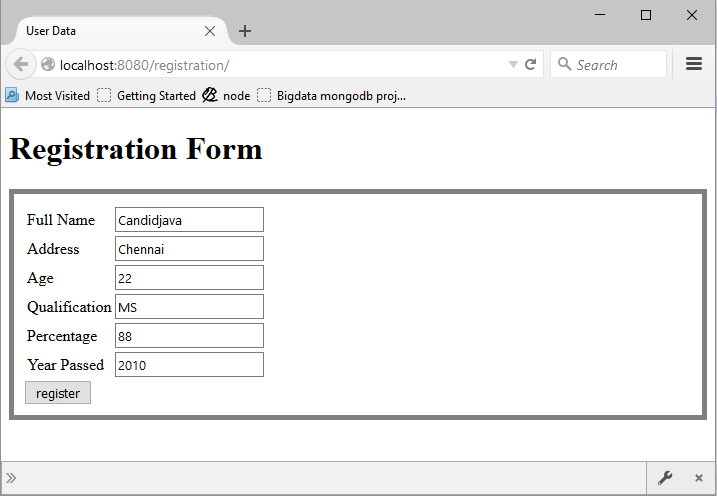
• We will have a register.html from where user can register to our application, we will provide it’s link in the login page for new user. User should provide email, password, name and country details for registration. If any information is missing, user will remain on same page with error message. If registration is successful, user will be forwarded to the login page with registration success information and they can use email and password to login.
When answering a question please: • Read the question carefully. • Understand that English isn't everyone's first language so be lenient of bad spelling and grammar. • If a question is poorly phrased then either ask for clarification, ignore it, or edit the question and fix the problem.
We will keep DB configuration details configurable through deployment descriptor. We will also add MySql Java Connector jar to the application libraries.
Visit here for login and logout application using cookies only In this example, we are creating 3 links: login, logout and profile. User can't go to profile page until he/she is logged in. If user is logged out, he need to login again to visit profile. In this application, we have created following files.
• We will use MySql database for persisting user information. We will create a new database, user and Users table for our application. Since our application totally depends on Database Connection, we will create a servlet context listener to initialize the database connection and set it as context attribute for other servlets.
Please help or guide me to solve this issue. Kalpesh sanjay zerwal i use this code,but i am tried to login with using student table data it doesnt goes to success or error page.it shows thread type something.please help me.what is exactly problem and how to solve it. Mathan Please post your error message bgufygiv oki.
Let's work to help developers, not make them feel stupid.
• Once the user logins successfully, we will create a session for the user and forward them to home.jsp where we will show basic information of the user. We will have a model class User that will store the user data into session. User home page also provide logout button that will invalidate the session and forward them to login page. • We need to make sure all the JSPs and other resources are accessible only when user has a valid session, rather than keeping session validation login in all the resources, we will create a Servlet Filter for session validation and configure it in deployment descriptor. • We will use Servlet 3.0 features for servlet configuration, listeners and filters rather than keeping all of these in deployment descriptor.
The source code is commented in details, so that can understand every statement's role. Finally, we are done with the logic and accessing the DB.
In this section we are going to discuss the implementation of a complete Login application (We received the source code of this application through Amira Thabet) The application will • Ask the user to input his 'username' and 'password' • Check the existence of this user in the Data Base • If exists, Retrieve his first name and last name from the DB and display them • If not registered, Display 'Sorry, you are not registered' You are assumed to know about the connection between java and DB. This Login application uses the so called 'JavaBeans' and 'DAOs' - standing for Data Access Objects - to handle the interactions with the DB. Beans are normal java classes containing • Attributes • Getters and Setters for such attributes (and may be some additional methods) In our application, Beans are used to save data needed in the application (in the form of variables). This data may be a representation of data existing in the DB, data entered by the user, or results of business logic. DAOs are objects responsible for handling the interactions with the Data Source, through implementing the access mechanism required to work with the data source. In our application the DAO is responsible for • Reading data from the Bean (data entered by the user) and checking its consistency with the DB - use Getters to get values of variables from the bean- • Retrieving data from the DB and saving it to the Bean - use Setter methods to set values to variables - You can either go to the Next page to step by step implement the example, or download its source code from.
How to make a simple Login page using Servlet & Session in NetBeans IDE 1. Open NetBeans IDE 2.
Email ID: Password: Name: Country: If you are registered user, please login. Deployment Descriptor and log4j configuration We will have log4j configuration file inside WEB-INF folder and it will be packaged with the application WAR file.
Here, we are going to create a real world login and logout application without using database code. We are assuming that password is admin123.
So back to the interface, we need two JSPs; one for the valid login and another for the invalid. 
• • • • • • •. Table of Contents • • • • • • • • • • • • • Servlet JDBC Example Develop a web application that should have following features. • User can register and then login to the application. • The users information should be maintained in database.
• Use standard logging framework log4j. • The application should support session management, no JSPs should be visible without session. Users can logout anytime from the application. • We should not show application and server details to user incase of any exception in application or other common errors like 404. Once we have our basic application ready, we can move on to add other features. Design Decisions • Since login page is the entry point of application, we will have a simple login.html where user can enter their credentials; email and password. We can’t rely on javascript validations, so we will do server side validation and incase of missing information we will redirect user to login page with error details.
We will use Eclipse for development and Tomcat 7 for deployment. Based on above requirements and design decisions, we will create our dynamic web project whose project structure will look like below image. Copy Register Page Provide all the fields for registration.
Servlet HttpSession Login and Logout Example We can bind the objects on HttpSession instance and get the objects by using setAttribute and getAttribute methods. In the previous page, we have learnt about what is HttpSession, How to store and get data from session object etc.
Nikhil Pahariya.
Run the Project(let server is Tomcat). Facebook: Blog.
• index.html • link.html • login.html • LoginServlet.java • LogoutServlet.java • ProfileServlet.java • web.xml File: index.html. LoginServlet LoginServlet LoginServlet LoginServlet /LoginServlet ProfileServlet ProfileServlet ProfileServlet ProfileServlet /ProfileServlet LogoutServlet LogoutServlet LogoutServlet LogoutServlet /LogoutServlet.
In our example, the response writer is saved to the variable 'out', so the method used to write to the response body will be out.println(). The final code written to the response body, representing the result page, will look like that:
One quick query, you are launching project through Eclipse “Run on Server” and it should be trying to open the project home page. Try to access the URL for “Register Page” as shown in the first image of the post. • yigwoo says. In AuthenticationFilter.java -> doFilter() method the code if(session == null &&!(uri.endsWith(“html”) uri.endsWith(“Login”) uri.endsWith(“Register”))) shouldn’t session == null &&!(uri.endsWith(“html”) be put in one parenthesis together?
Pinterest Comments manvendra pratap dubey i want code for dynamic data validation.u have done it for static data.please help with that and also for registration page. Thanks in advance sudheer please tell me external css folder witch please inserted this project and how call the jsp page in css sunish thanks so much may god bless u Pradeep Thank you. Navyakantha good navyakantha i want more data anil how to execute this in eclips Anand vardhan reddy could you let me know how to create envirement for simple login and save the data in database. Candidjava Sure Anand vardhan reddy, will update you the code in couple of days Vaibhav Shukla I want to create 2 servlet file in dynamic Web Application using Eclipse. One I want to used for Login page and Second is for Calculation page with-in same Package in eclipse even. I tried number of time but it throw resource not found HTTP Error 404.
The user starts to interact with the page by entering the required fields - in our example we have only one field which is 'color' - and then clicking the submit button. The servlet writes the appropriate HTML code to the response message. In our example, this writing takes place when executing the doGet method. To execute the doGet method, the servlet will: • Extract the value of the parameter 'color' from the request message - In our example, the value of the parameter 'color' is 'red' - using request.getParameter('color') and save it into a new variable named 'color' (the variable is of type 'String'). • Get the writer of the response, so as to be able to edit the body of the response message, using response.getWriter(); and save it to a variable named 'out' (the variable is of type 'PrintWriter'). • Write to the response using the println method of the response writer object.
• Since we want to use log4j and configure it properly before usage, we will utilize servlet context listener to configure log4j and keep the log4j configuration XML file location in web.xml init parameters. We will write our application logs in a separate log file dbexample.log for easier debugging. • Incase of any exceptions like “Database Connection Error” or 404 errors, we want to present a useful page to user. We will utilize servlet exception handling and write our own Exception Handler servlet and configure it in deployment descriptor.
Make a new Project as: 2.1 File~NewProject~Java Web~WebApplication 3. Make a servlet(say First.java) as: 3.1 RightClick on Source Package~New~Other~Web~Servlet 3.2 Name your Servlet 3.3 Check Add Information to deployment descriptor(web.xml file) 4. Make another servlet(say Second.java). Make an HTML file as: 5.1 RC on Web Pages folder and select New~Other~Web~HTML 5.2 Design a simple form in HTML 5.3 Give the url-pattern of First Servlet in the 'action' attribute(say '/First') 6. Write code for First.java to authenticate the user 6.1 In this servlet set the session attribute with a 'key' and its 'value'. Write code for Second.java to view the profile 7.1 In this get the attribute of session.
Insults are not welcome. • Don't tell someone to read the manual. Chances are they have and don't get it. Provide an answer or move on to the next question.
Hi pankaj, i just pasted your code as it is and according to directory structure. But it is not working. The error is: HTTP Status 404 – /ServletDBLog4jExample/ ——————————————————————————– type Status report message /ServletDBLog4jExample/ description The requested resource (/ServletDBLog4jExample/) is not available. ——————————————————————————– Apache Tomcat/7.0.23 Yes am using the same Tomcat server in both Eclipse and Netbeans, but not same time ie netbeans tomcat is in stop mode pls help me out? The issue is clearly in deployment, try to export project from Eclipse and WAR file and then deploy it in standalone Tomcat, not through Eclipse and see if it runs fine. Deploying in standalone tomcat helps in debugging because you can easily check the server logs for any deployment issues.
Servlet JDBC Database connection and Log4j integration is the topic of this tutorial. We have provided a lot of tutorials on servlets in java, this tutorial is aimed to use all of those information to create a full-fledged web application with database connectivity and log4j integration for logging. I strongly recommend to check out following tutorials if you are not familiar with any of these. All of them contains sample project that you can download and run for understanding the core concepts of Servlet API.
Web.xml FirstServlet FirstServlet WelcomeServlet WelcomeServlet FirstServlet /servlet1 WelcomeServlet /servlet2 index.html Output: i. Enter username or password ii. Correct username and password.
Web.xml FirstServlet FirstServlet WelcomeServlet WelcomeServlet FirstServlet /servlet1 WelcomeServlet /servlet2 index.html Output: i. Enter username or password ii. Correct username and password.
The client requests the home page () and the server replies with the HTML code of the requested page. Once the client requests to view a certain page by writing its URL (in our example the URL is ), the server replies to this request by sending the corresponding HTML data which is displayed by the client's browser. <%@ page language='java' contentType='text/html; charset=ISO-8859-1' pageEncoding='ISO-8859-1'%> Note that this URL, does not refer to a certain file, it refers to the project 'ServletExample'; In this case, the server looks for a 'Welcome-file' in 'web.xml' and replies to the request using this file. In case the server did not find a 'Welcome-file', it displays the so called 'Directory-Listing' that shows links to the HTML and JSP pages of your project.
Copy <%@page import='com.journaldev.util.User'%><%@ page language='java' contentType='text/html; charset=US-ASCII' pageEncoding='US-ASCII'%> Hi <%=user.getName()%> Your Email: <%=user.getEmail()%> Your Country: <%=user.getCountry()%> The JSP page still contains a lot of java code because we are not using JSP tags, we will look into this in JSP tutorials. As of now please bear with this.
Run the Servlet JDBC Example Application Our application is ready for execution, I would suggest to export it as WAR file and then deploy to tomcat rather than deploying it directly to Tomcat server from Eclipse so that you can easily look into the log4j log file for debugging. Some sample execution pages are shown in below images. User Registration Page: Registration Success Page: Login Page: User Home Page: 404 Error Page: Input Validation Error Page: log4j Log File: dbexample.log. Every web app has it’s own servlet context from which Container knows which application to redirect the request. For example localhost:8080/app, here “app” is the servlet context of the application.